Created a medieval screen from repurposed bi-fold doors, window drapes, and some used embroidery floss. The screen is 10 feet wide and 7 feet tall. A way to display page-size embroidered patches featuring medieval scenes.
Katz, Israel J. and Keller, John E. Studies on the Cantigas de Santa Maria: Art, Music, and Poetry Proceedings for the International Symposium on the Cantigas de Santa Maria of Alfonso X, el Sabio (1221-1284) in commemoration of its 700th year. Madison: The Hispanic Seminary of Medieval Studies, Ltd. 1981.
Keller, John E. and Cash, Annette, G. Daily Life Depicted in the Cantigas de Santa Maria. Lexington: The University Press of Kentucky. 1998.
Montagu, Jeremy. The World of Medieval & Renaissance Musical Instruments. New York: The Overlook Press. 1976.
Sahs, Curt. The Rise of Music in the Ancient World East and West. New York: W.W. Norton & Company: 1943.
Smith, Bradley. Spain: A History in Art. Garden City, New York: Doubleday & Company.
Starkie, Walter. Spain: A Musician’s Journey Through Time and Space. Geneva, Switzerland. Editions Rene Kister. 1958.
Las Cantigas de Santa Maria is a manuscript made up of four codices that depicts the daily life, religious beliefs, music, customs, and art from the 13th century, of the courts of Castile and Leon in Northern Spain. In codex J.b.2, there are approximately four hundred and twenty-seven compositions in honor of the Virgin Mary; with every tenth cantigas (song) beginning with a miniature; an illumination of musicians playing instruments. I had begun embroidering again, and had found two images from this codex that I had used the Split stitch with. Then I learned the Laid Work stitch at a local Fiber Arts Guild, and I thought it would be interesting to apply this technique to a medieval picture. The musicians and instruments were a great match, and I have been busy finding more images to embroider over the years.
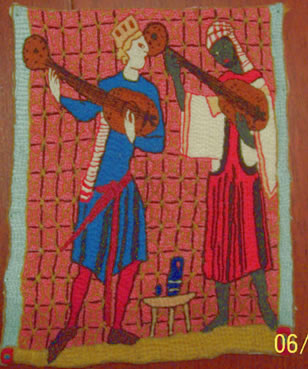
Christian and Moor musicians playing guitar-like instruments
This picture I call Christian and Moor Playing Guitar-Like Instruments, for I don’t believe I have found titles for each of these miniatures. I have seen this image in several different books and on web sites, and each time I saw it, the eyes of the Moor musician were scratched out. It was a thrilling experience to put his eyes back in as I embroidered him in this patch. My favorite resource for this image I found as a tile that was tipped-in to the book. The book is volume one of a 2-book set entitled: Spain: A Musician’s Journey through time and space by Walter Starkie.
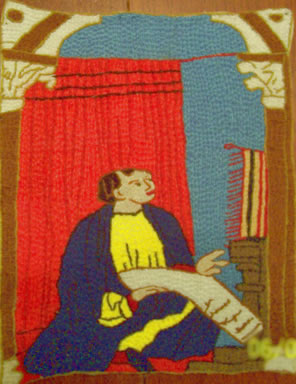
This picture is actually a fifth of the original. I took a long image from LasCantigas de Santa Maria that depicts King Alfonso the Wise directing his musicians and scribes as he writes a cantigas for the Virgin Mary. This panel is of some of the musicians with the center image being of the king.
Scribe taking direction from King Alfonso the WiseKing Alfonso the Wise directing his scribes and musicians
This is the picture of King Alfonso the Wise directing his scribes and musicians. I am very impressed with the artists’ paintings in this manuscript and have thoroughly enjoyed reading about this king, the music of his era, and embroidering the patches from the miniatures. This image and the one above it I have found in black and white as well in color, in many of the resources listed in the Resources panel of this blog. However, the image I ended up using came from the book: The Learned King: The Reign of Alfonso X of Castile, by Joseph F. O’Callaghan.
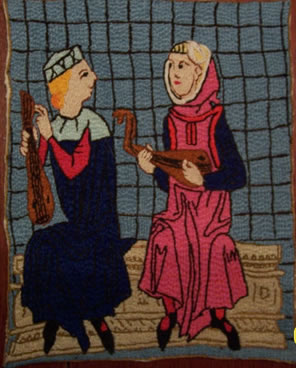
Christians playing viol-like instruments
I call this patch; Two Christians playing Viol-like Instruments. This back ground has always been hard for me to capture, as based on the quality of the scan, I may or may not get a design that is clear enough to embroider. When I look at these patches I sometimes think that they are crude and not clear enough. However, as the scanning technology and graphic arts software improve and become more affordable for me, I feel that the images will become clearer and thus easier to embroider. This image I found in the book: The World of Medieval and Renaissance Musical Instruments by Jeremy Montagu.
Las Cantigas de Santa Maria is an amazing manuscript that tells us about the people of that time and region, giving us not only colorful images of people, animals, buildings, clothing, and traditions, it also gives us music that can be played and learned today. There are pages of poems, songs, and musical notation that have been translated and learned, and recorded on DVD for those interested. It is a wealth of knowledge, so much so that there is a Centre for the Study of the Cantigas de Santa Maria of Oxford University, created in 2005. Look for the link on the side panel under Related Links.
I applied Laid Work to the images from Las Cantigas de Santa Maria.This embroidery technique was used in the eleventh century art piece known as The Bayeux Tapestry.It isn’t really a tapestry as it isn’t woven.It is actually embroidered work by several workers, who created the images to show the story of the Battle of Hastings of 1066. When looking at the Laid Work from the Bayeux, it is clear that the artists were in a big hurry, as their stitches are wide and not even. Some scholars say that the tapestry was commissioned or ordered by William the Conqueror or his brother, Bishop Odo.
The Laid stitch is simply a satin stitch with spaced-out threads laid vertically to the satin stitch, and couched down. This gives a rippling effect over the entire image.It also strengthens the area, so in many cases in this time period, this stitch was also used to develop patches.These beautiful patches would be applied to clothing, outlive the clothing, and be removed and reattached to new cloths.My stitches are significantly more even and tight than those found in the Bayeux Tapestry as I didn’t have a king demanding that my work be turned out by a certain deadline.
I displayed the embroidered patches from the Cantigas in an exhibit in the Norlin Library at the University of Colorado-Boulder. The comments were quite encouraging, as the campus community shared their amazement of the images from such an old piece of history, as well as the beautiful embroidered stitches that allowed them to be hung in a display. The comments also related their desire to see more art work from our history, and enjoyed knowing how these artistic skills can be learned and the local organizations and guilds that are around to provide assistance in learning them.



 NewMedievalArt